
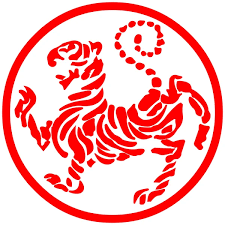
The tiger enclosed in a circle is the most recognisable image in modern karate. It is not a decorative drawing: behind it lie a scholarly pun, a hill in Okinawa, and an irony few people know.
The Origin of the Design — A Pun, Not a Legend
The image was created by Hoan Kosugi, a well-known Japanese painter, a close friend and at the same time a student of Gichin Funakoshi.
It was Kosugi who persuaded Funakoshi to write the first book on karate ever published — Ryūkyū Kempō: Karate, which appeared in 1922 — promising in return to design the cover.
The idea of the tiger comes from a learned play on words. In Japanese, the expression tora no maki (虎の巻) denotes the reference document, the definitive manual of an art — the scroll containing the essence of a transmission. Kosugi regarded Funakoshi’s book as the tora no maki of karate. And since tora (虎) also means “tiger,” he drew a tiger.
At its origin, therefore, the symbol means knowledge, not force. The tiger on the cover was saying, to anyone who could read it: this is the definitive book.
The Hill Already Called “Tiger’s Tail”
Here the circle closes, in a way most accounts miss.
Funakoshi signed his poems with the pen name Shōtō (松濤) — “pine waves.” He explained it himself, later in life: as a young man, after days of teaching at the local school and hours of hard training, he would climb alone a hill near Shuri to meditate among the pines. The wind moving through the branches made a sound which, he said, resembled waves breaking on the shore.
That hill was called Torao (虎尾) — “tiger’s tail.” Narrow and heavily wooded, seen from a distance it did indeed resemble a tiger’s tail.
So the place that gave him his pen name already bore the animal’s name. Kosugi’s tiger is not merely a pun on the book’s title — it is also the hill on which Funakoshi became a poet. The two explanations, which you will usually find presented separately, are in fact one.
The Name He Never Asked For
From Shōtō and kan (house, hall) the style’s name was formed. But it was not Funakoshi who chose it.
In the spring of 1936, a committee of supporters raised funds to build the first dedicated dojo, in the Zōshigaya district of Tokyo. At its opening, the students placed above the door a sign reading Shōtōkan — “the house of Shōtō.” The name came from them, as a mark of respect.
The irony is worth stating: Funakoshi opposed the division of karate into styles. He held that there was a single art, and that separate names fragmented it needlessly. He was thus given the label of a school he had never wished to set apart from the rest — and that label carried his name onward in exactly the way he had never wanted it carried.
The Tiger: Between Force and Self-Control
The tiger symbolises vital energy, courage and the force of nature. In the context of karate, however, it came to mean something else: interiorised force — the power you control rather than display.
In the Chinese art from which the motif derives, the tiger has one precise attribute: it never sleeps. This is not the tense vigilance of one who is afraid, but the quiet attention of one who has nothing to prove. The practitioner learns that real power lies not in the strike but in the choosing of the moment. The tiger watches calmly, and reacts with precision.
The Circle — and What We Actually Know About It
A point of honesty is due here, because several explanations circulate as though they were documented.
Kosugi left no interpretation of the circle. What we read into it today are readings accumulated over a century of practice — valuable, but later than the drawing. Two have taken hold:
Power held in check. The tiger’s force is not used at random; it “breaks” from the circle only to defend yourself, or one who cannot defend himself. In this reading, the circle is the very line between martial art and violence.
The endless road. Close to the Zen ensō — the circle drawn in a single stroke of the brush — this reading holds that the art has no end point, only a continuous path. Perfection does not mean rigidity but harmony with oneself.
That the meanings came after the drawing does not make them less real. A symbol is alive precisely because the generations carrying it invest it with meaning. But a mature practitioner is entitled to know what is documented and what has been added.
What Remains
The Shotokan tiger is not a logo. It is the visual synthesis of a philosophy:
Force + Discipline + Learning without end.
A true practitioner shows his teeth only when it is necessary. Until then he trains in silence, within his own circle of concentration — much as a young schoolteacher once climbed, in the evenings, a hill called “the tiger’s tail,” to listen to the wind through the pines.