Mokuso (黙想) translates literally as “silent thought” — 黙 moku, silence, and 想 sō, thought or contemplation.
It is the moment of stillness at the beginning and end of training, present in karate, judo, aikidō and kendō.
It looks like the simplest thing in the dojo. It is, in fact, the one part of training most practitioners perform without knowing what they are doing.
Where It Actually Comes From
The connection between mokuso and Zen is real at the level of general influence — the vocabulary, the posture, the idea of mushin all come from there. But it is worth stating plainly, since the opposite is frequently claimed: mokuso, as a fixed dojo ritual, is not a thousand years old.
The practice as we know it — a brief seated meditation opening and closing the session — was formalised alongside the transformation of the Japanese martial arts into educational budō, in the late nineteenth and early twentieth centuries. Karate adopted this protocol comparatively late: in Okinawa, where the art took shape, training did not follow Japanese dojo etiquette. The structure we use today arrived with the transplant to mainland Japan in the 1920s, through Gichin Funakoshi, who adopted the dojo conventions of kendō and judo — including the keikogi, the belt system and the opening ritual.
It is sometimes also claimed that Japanese masters incorporated pranayama from Indian yoga. There is no evidence for this. Zen has its own tradition of breath work — susokukan, the counting of breaths — which does not derive from yoga.
None of this diminishes the practice. A ritual is no less valuable for being a century old rather than a millennium. But a serious practitioner ought to know what he has inherited, and from whom.
What It Actually Does
Before training: the switch. You have arrived from traffic, from the office, from an unfinished argument. Mokuso is the boundary. It does not make you forget what you left outside — it makes you notice that you brought it in with you, which is enough to be able to set it aside.
After training: decompression. The session ends with an elevated heart rate and the sympathetic nervous system engaged. Two minutes of stillness mark the transition back. This is also where the brief review of what worked and what did not takes place — not as self-criticism, but as observation.
In both: training attention. What you practise in mokuso is not stillness. It is return. The mind wanders — that is what minds do. The moment you notice it has wandered and bring it back is the only moment of genuine training. A beginner who loses attention thirty times in two minutes and retrieves it thirty times has done more work than one who happened to sit quietly throughout.
How to Practise
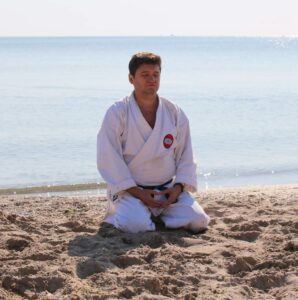
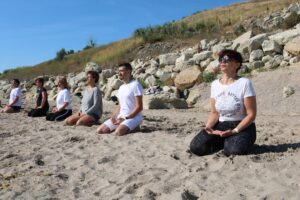
Posture. Seiza is the traditional form, but if the knees will not allow it — and past forty they often will not — sitting on a chair is entirely acceptable. What matters: spine vertical, shoulders down, weight settled. Not rigid; upright.
The hands. In mokuso they usually rest on the thighs, or form the hokkai jōin: left hand over right, palms up, the tips of the thumbs lightly touching. The position has a practical function: the moment attention slackens, the thumbs either separate or press together. It signals for you.
The eyes. Contrary to expectation, in the Zen tradition the eyes remain half-open, gaze lowered a few paces ahead, fixing on nothing. Fully closed eyes invite drowsiness and mental imagery. Mokuso is not visualisation.
The breath. Through the nose, in both directions. Breathe into the abdomen, not the chest. Make the exhalation longer than the inhalation — this is the detail that matters, because a prolonged exhalation engages the parasympathetic branch of the autonomic nervous system and slows the heart. Without forcing: the breath lengthens by itself if you do not hurry it.
Where to place attention. Not on a concept, not on a word, not on “energy.” On the breath — on the physical sensation of the air, or on counting exhalations from one to ten, beginning again at one each time you lose the thread. The method has a name: susokukan. It is simple, and simultaneously the most honest mirror available: it shows you exactly how far you can count before you drift.
Duration. In the dojo, a minute or two. At home, begin with five minutes and increase slowly. Regularity matters more than length — five minutes daily beats thirty minutes once a week.
Ending. Open the eyes gradually, move the fingers, then the shoulders. Do not stand abruptly.
What the Research Says — and What It Doesn’t
Spectacular figures about the effects of meditation are frequently quoted. They deserve replacing with what can actually be supported.
A meta-analysis of 34 randomised trials (Koncz et al., Health Psychology Review, 2020) examined the effect of meditation interventions on cortisol. The result: a significant, medium-sized effect — but principally in at-risk populations, meaning people with somatic illness or living in stressful circumstances. In healthy individuals, the effect on salivary cortisol was small and not statistically significant.
Another meta-analysis (Psychoneuroendocrinology, 2023) places mindfulness and meditation interventions at an effect size of 0.345 — small to medium, among the better performers in the category of stress management interventions, but far from the figures in circulation.
The practical translation: meditation works, the effect is real and measurable, but it is modest, and it shows up most strongly in those who need it. Anyone promising to transform you in two minutes a day is selling you something else.
And here something is worth noticing: in the dojo, mokuso is not practised for cortisol. It is practised because it marks a threshold — and thresholds have value independently of their biochemistry.
Why It Matters Past Forty
The capacity to sustain attention declines with age earlier and more quietly than strength does. You do not notice, because there is no mirror for attention as there is for the body.
Mokuso is that mirror. Two minutes a day will tell you, without flattery, how fragmented your mind is at present. It is the cheapest and most useful information you can obtain about yourself.
One Thing Worth Keeping
Mokuso is not done well or badly. It is done, or it is not done.
The session in which the mind fled a hundred times and you brought it back a hundred times is a successful session. That is the practice. The rest is merely quiet — and quiet may arrive, or it may not, and if you go looking for it, it certainly will not.